Everything you need to know before your stay.
The Glottenham Guide
Welcome to Glottenham — a historic farm in the High Weald of East Sussex, cared for through conservation and environmental stewardship.
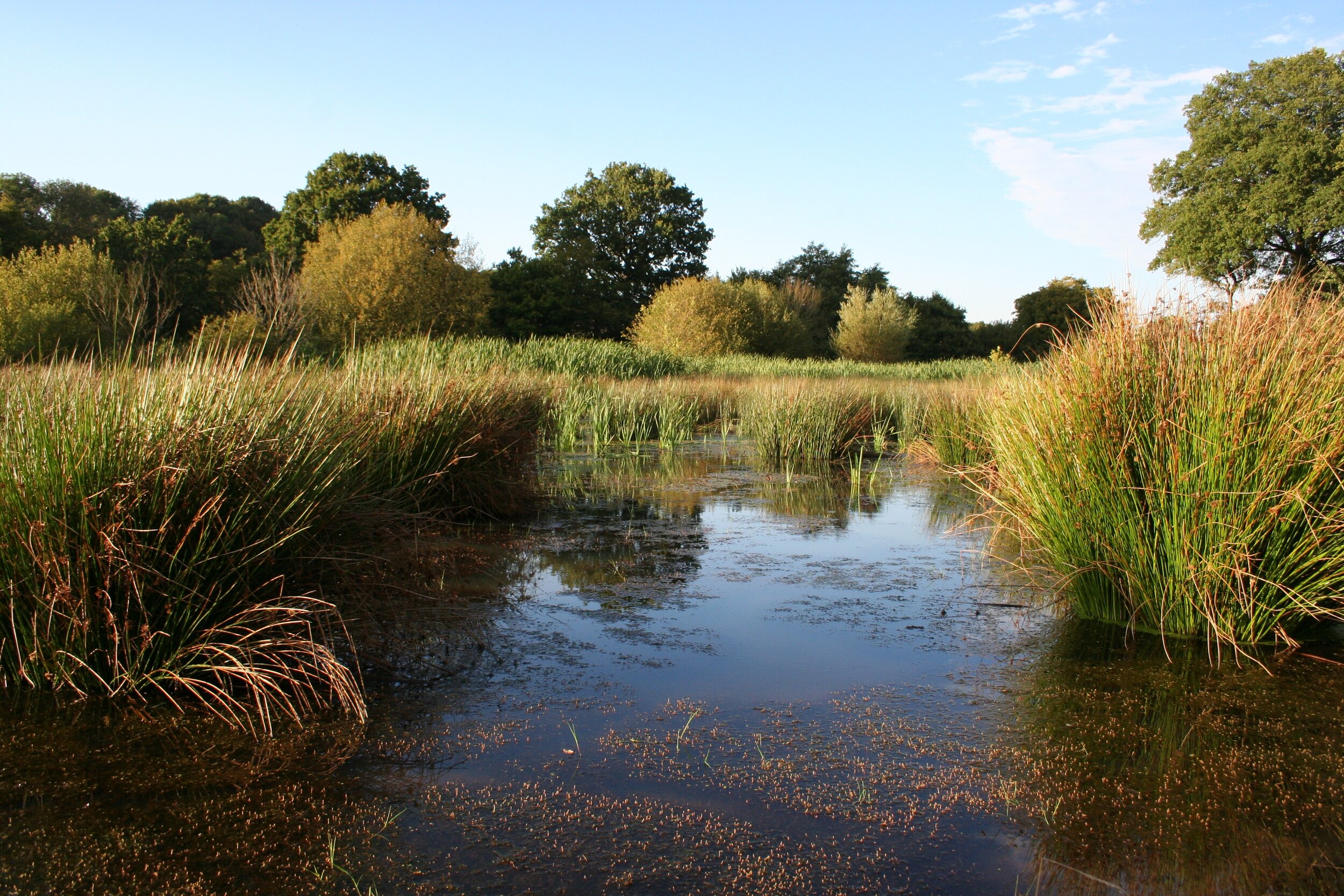
The landscape here is as much a part of Glottenham as the places you stay. Ancient woodland, meadows, wetlands, ponds and hedgerows provide space for wildlife, and we're continually working to protect and encourage the natural life of the farm.
Our aim is to look after the land and create the conditions for wildlife to flourish — from wildflowers, insects and birds to the larger creatures that pass through the landscape. Some of the grassland is grazed by sheep and cattle brought in by a neighbouring farmer, but this isn't a farm with animal experiences or a working farmyard. It's a place to experience the landscape itself.
Staying here is about slowing down and noticing what's around you. Waking to birdsong, walking through the woods, watching the meadow change with the seasons, cooking outdoors and gathering around the fire as evening falls.
This Guide is here to help you make the most of your time at Glottenham. You'll find practical information about arriving and settling in, what to bring, how things work here, and ideas for exploring the farm and the wider High Weald.
Take what you need, leave a little room for discovering things for yourself.
Choosing your stay
There are several ways to experience Glottenham, from secluded cabins and canvas retreats to simpler stays beneath the trees.
Each has its own character, and the right choice depends on how you'd like to experience the landscape.
Rossetti.
A woodland cabin for up to five, tucked amongst the trees.
De Etchyngham
A secluded geodome for two, with views into the surrounding landscape — and a little more comfort and privacy for a couples' escape.
De Glottyngham.
A larger woodland cabin sleeping up to six, well suited to families and groups.
Bodichon.
A spacious yurt in the wildflower meadow, sleeping up to six, with the wider landscape right outside.
For those who want to sleep even closer to the landscape, our Nearly Wild Camping offers a more informal way to stay at Glottenham.
Depending on the season and what's happening at the farm, there may be a variety of ways to stay — from bringing your own tent to staying in one of our occasional vintage caravans, with erected tents sometimes available too.
It's a simpler, more flexible side of Glottenham, and one that changes and evolves with the seasons.
Not sure which is right for you? We're happy to help.
Before you arrive
What to expect
Glottenham is a little different from a conventional holiday stay — and that's part of its charm.
Our accommodation is deliberately close to the landscape, with simple facilities designed to help you slow down and spend more time outdoors. There is no mains electricity in the accommodation, so you'll find battery lanterns rather than electric lights, and we encourage you to embrace the chance to switch off from the usual routines.
You'll be surrounded by ancient woodland, meadows, wetlands and the wildlife that lives here. Paths can be uneven and muddy, the weather can change quickly, and much of life here happens outside — so come prepared for the elements and ready to get your boots a little dirty.
Each accommodation has its own facilities, including a kitchen with a double gas hob, pots, pans, crockery and cutlery, a cool box and a private BBQ and pizza oven. There is fresh drinking water, hand and dish washing facilities and a private composting toilet for each unit and two outdoor hot water showers which are shared between guests. You'll find more information about how everything works in the Guide below, so there's no need to remember it all before you arrive.
There is also plenty of opportunity to simply do very little. Sit outside with a coffee, wander through the woods, cook over the fire, watch the birds, or settle down beneath the stars. There's no timetable at Glottenham unless you want one.
What to pack
Come prepared for being outdoors and for changeable Sussex weather.
We recommend bringing:
Comfortable walking shoes or boots
Waterproofs and warm layers
Clothes you don't mind getting muddy or smoky around the fire
Torch or headtorch — although battery lanterns are provided
Personal toiletries
Food and drinks for your stay, unless you've ordered one of our hampers
Any medication or personal essentials you need
Wellies can be particularly useful after wet weather
Bed linen and towels are provided, along with battery lanterns and spare batteries. There is no mains electricity in the accommodation, so if you need to charge your phone or other devices during your stay, bring a power bank or use your car charger.
Dogs
Dogs are welcome at Bodichon and de Etchyngham, and we want them to enjoy Glottenham too.
We provide two dog bowls, a dog bed and a blanket for your stay, although you're very welcome to bring your dog's own familiar things as well.
Each dog-friendly space has a tethering post, so your dog can relax outside with you. Dogs need to be kept on leads around the farm, although you can use an extendable lead from the tethering post at your accommodation.
For everyone's comfort:
Bodichon can accommodate up to two dogs.
de Etchyngham can accommodate one dog.
Please feed dogs outside.
Dogs aren't allowed on the furniture.
We provide compostable dog poo bags and a dog-waste bin — please use them and help us keep the farm clean.
Please don't take dogs into the areas where dogs aren't permitted. This is important for guests who may be nervous or uncomfortable around dogs, as well as for the wildlife and other animals on the farm.
Your dog is very welcome to enjoy the outdoor space around your accommodation with you — just remember that Glottenham is a rural landscape with wildlife, livestock and other guests, so keeping them close and under control helps everyone enjoy their stay.
Families
Glottenham can be a wonderful place for children to explore. There is plenty of space around the accommodation and within the Glottenham camping and glamping areas to play, wander and investigate the natural world.
At the same time, Glottenham is a real rural landscape, with ponds, streams, woodland, uneven ground and areas that are not part of the guest site. Children should therefore be supervised by an accompanying adult, particularly around water and when exploring beyond your accommodation.
The wider farm is not an open playground, and some areas — including the farmyard, barns and working areas — are private and out of bounds to guests. Please help children understand where they can explore and where they shouldn't go.
There is plenty to discover without going far: insects in the meadow, birds in the trees, tracks and signs of wildlife, woodland paths and the changing seasons.
Accessibility
Glottenham is a rural site, with woodland paths, grass meadows, uneven ground and streams. Reaching the accommodation means walking across natural terrain, and paths and surfaces can become muddy after wet weather.
The accommodation isn't designed as accessible accommodation, and some spaces involve steps or uneven approaches. Composting toilets and outdoor showers may also present additional challenges for some guests.
If you have particular access requirements, please get in touch before booking. We're always happy to talk through the individual accommodation, the terrain and what you can expect, so that you can decide whether Glottenham is right for you.
Food & hampers
You can bring your own food and make use of the kitchen facilities in your accommodation, or order one of our Glottenham hampers before you arrive.
Our hampers use produce from local suppliers and include options for breakfast, barbecues, plus meat or veggie pizzas. Hampers are prepared in a cool box and waiting for you when you arrive.
We can also put together specialist or bespoke hampers for special occasions with a little more notice. If you're celebrating something or have particular requirements, get in touch and we'll see what we can arrange.
Likewise, if you have additional requirements for wine, meat or other produce, we can source these from our biodynamic organic farm shop.
Eggs and Glottenham honey are also usually available directly from the farm, depending on what's available at the time.
Hamper orders need to be made in advance:
Friday arrival: order by the preceding Monday
Monday arrival: order by the previous Wednesday
If you'd like to order a hamper, or have a question about what's currently available, please email us and we'll be happy to help.
When you arrive
Finding the farm
Glottenham is tucked away in the countryside, so please follow the directions below rather than relying entirely on your sat-nav.
Our Google Maps location and What3Words address will bring you to the farm:
Google Maps: https://maps.app.goo.gl/tiz9oddqHPuQ5rzFA
What3Words: castle.cherubs.seasonal
For individual accommodation:
Bodichon: acted.shortens.writers
Rossetti: lamplight.shielding.branching
de Glottyngham: save.evaporate.pixies
de Etchyngham: shepherds.agreeing.glorified
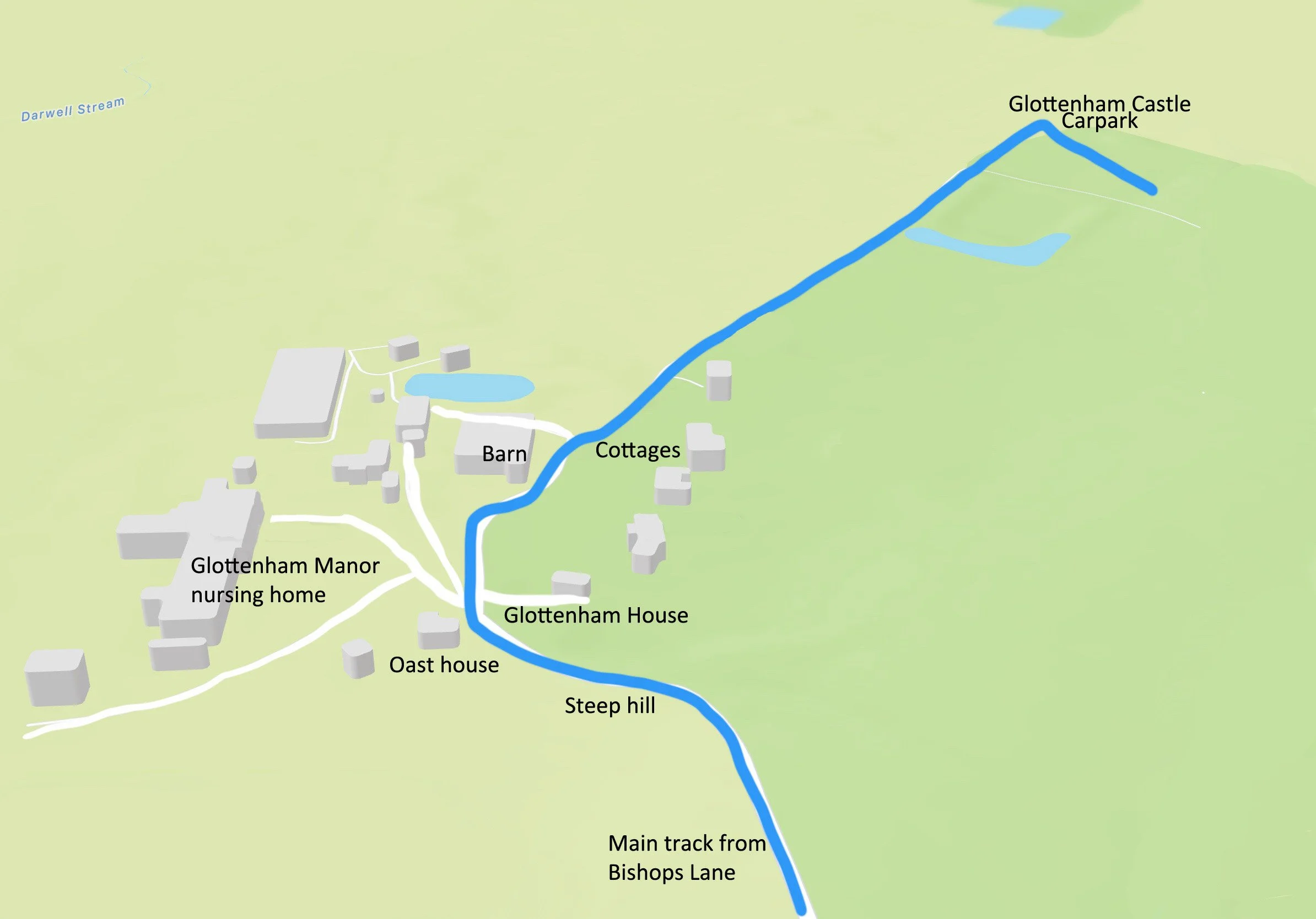
From Bishops Lane, look for the sign for Glottenham Manor Nursing Home and turn onto the farm track. Follow the track for approximately a mile.
At the top, take the right-hand fork, then continue past the barn and cottages. The campsite car park is on your right. about 500 yards up the unmade track
Please drive exceptionally carefully along the farm track and around the farm. It is narrow in places and we have other residents, farm traffic and wildlife sharing the route.
Parking
There is a dedicated car park at the site, but it is not possible to drive right to your accommodation.
Wheelbarrows are available to help you carry your belongings from the car park to your accommodation. Please return them to the car park when you've finished unloading.
Check-in
Glottenham is self check-in, so you can arrive and settle in at your own pace.
Your accommodation will be ready from 4pm on the day of arrival. On occasion, we may be able to let you arrive a little earlier — if so, we'll let you know by text.
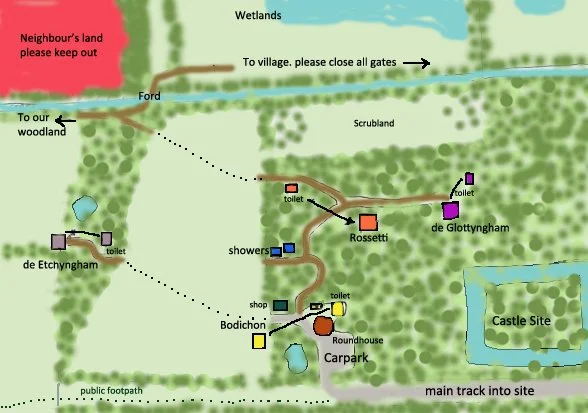
When you arrive, please make sure you know which accommodation you've booked and use the site map to find your way from the car park.
Please note that the toilet and washstand beside the car park are for the sole use of guests staying in Bodichon. Please do not use these facilities if you are staying in another accommodation.
Please keep children with you while you're finding your accommodation and getting settled in, rather than allowing them to explore ahead.
Once you've found your space, you're free to settle in and make yourself at home.
Settling in
Once you're settled in, take a little time to get your bearings. Your accommodation has everything you need for your stay, and the Guide below explains how the different facilities work.
Firewood
We provide complimentary firewood and kindling to get you started. Additional firewood, kindling, firelighters and charcoal are available from the honesty shop. Please bring some cash if you'd like to make use of it.
The Roundhouse
The Roundhouse is a shared space at the farm and is sometimes used for courses and therapies. When it isn't in use, you're welcome to have a look inside.
There's a book exchange in the bookcase to the left of the door. You're welcome to take a book to read during your stay, or leave one for someone else to discover.
The large bookcase on the far side of the Roundhouse contains personal books belonging to the Glottenham team — please feel free to read them, but make sure they are returned to the correct bookcase so they don't get taken home by mistake.
Living gently here
Composting toilets
Our composting toilets are simple to use, but they do work differently from a conventional toilet.
Please don't put toilet paper down the toilet. All toilet paper goes into the bin provided beside the toilet. This is really important, as paper in the composting system can cause problems and means someone has to remove it by hand during cleaning.
For the toilet to work properly:
Please sit down to use the toilet, including men when urinating.
Please don't put nappies, sanitary products, wipes or anything else down the toilet.
After using the toilet, cover your deposit with a small handful of the sawdust provided. Please use only enough to cover it — a little goes a long way.
It sounds like a small thing, but getting this right makes a huge difference to keeping the toilets clean and working properly — and means the next guests get to start their stay with a nice clean toilet!
Rubbish & recycling
We try to keep waste at Glottenham to a minimum, and we ask you to think about how much rubbish you generate during your stay.
Green compostable waste can go into the composting bin provided. Please follow the guidance on what can and can't go in the compost.
Black-bin rubbish needs to leave with you when you go. Our location means that a standard refuse collection lorry cannot reach the site, so we're unable to provide a normal household rubbish collection.
Please bear this in mind when packing and shopping for your stay. Choosing products with less packaging, bringing reusable containers and avoiding unnecessary single-use items can make it much easier to take your rubbish home with you.
Please don't put your rubbish in bins belonging to the farm or our neighbours.
Water
Each accommodation has its own standpipe connected to the mains water supply, with 10-litre water carriers provided for you to fill as needed.
Fresh drinking water is available throughout your stay. You'll also have a washing-up bowl, washing-up liquid and hand wash.
The composting toilets are one of the ways Glottenham keeps its water use low. They don't use any water to flush, so unlike a conventional toilet, every visit to the loo doesn't use litres of drinking water.
Please use the water thoughtfully during your stay, but you don't need to worry about rationing it — simply refill your water carriers from your standpipe when needed.
Fire
Fire is part of the Glottenham experience, both indoors and out.
Each accommodation has a woodburner, with firewood provided. The wood is hardwood and cut specifically to fit the woodburners. Please use the wood provided by Glottenham rather than bringing your own wood, coal, briquettes or other fuels. The wood we provide is chosen to burn cleanly and help reduce the build-up of creosote in the chimney flues. Using unsuitable fuels can increase the risk of chimney fires.
Each accommodation also has its own outdoor firepit, which is designed for use with the BBQ and pizza oven. Complimentary firewood and kindling are provided to get you started, with additional wood, kindling, firelighters and charcoal available from the honesty shop.
Please make sure fires are properly managed and never leave a fire unattended. If weather conditions make having an outdoor fire unsafe, we may ask you not to light one.
Each accommodation has a dedicated ash bin outside the door. Please put cooled ash in this bin rather than disposing of it elsewhere — we'll take care of emptying it.
Fire safety
Fire tools, heat-resistant gloves, a small fire extinguisher and a fire blanket are provided in each accommodation. Larger fire extinguishers are also positioned around the site.
Please familiarise yourself with the fire equipment when you arrive and make sure everyone in your group knows where it is.
Our farm fire policy is in the information folder in your accommodation. Please take a moment to read it when you arrive.
Looking after the landscape
Glottenham's woodland, meadows and wetlands are home to a lot of life, and some of it is easy to overlook.
Please don't pick wildflowers in the woodland. The woodland is ancient and the plants growing there are part of a fragile ecosystem. The wildflower meadow is different — there are plenty of flowers there, and you're welcome to pick a small bunch.
You'll also find fallen branches and dead wood around the woodland. Please leave these where they are. Dead and decaying wood is an important habitat and provides food and shelter for insects, fungi and other wildlife.
There are some longer pieces of wood around the site which we've deliberately left for children to use for dens and imaginative play. Please don't cut or break up other fallen wood for fires. There's plenty of firewood provided, and buying additional wood from the honesty shop helps us look after the woodland too.
Living alongside wildlife
One of the joys of staying at Glottenham is that you're staying in nature, rather than next to it.
Wildlife doesn't always know where the guest area ends. Squirrels may help themselves to unattended food, and our resident badger has been known to investigate an unattended BBQ from underneath Bodichon.
You may hear mice, birds or squirrels scratching or scampering on the roof or underneath your accommodation, and very occasionally something small may find its way inside.
And yes, there are spiders, insects, slugs, snails and all the other little creatures that come with being outdoors, particularly after wet weather.
You're in nature, so expect nature. It's part of the experience — and we'd love you to enjoy noticing who's sharing the landscape with you.
Consideration for other guests
Glottenham is a place for quiet, outdoor living, and most guests naturally fit into that rhythm.
Please be considerate of other people staying here. Amplified music isn't permitted, and we'd ask you to keep noise to a level that doesn't disturb other guests, particularly in the evening and at night.
Wildlife
We share this farm with deer, owls, bats, foxes, slow worms, dragonflies and countless other creatures. The landscape is managed to protect and encourage the wildlife that calls Glottenham home, and we're now part of the Higher Tier agricultural environmental stewardship scheme, with a Higher Tier woodland scheme also in the pipeline.
Depending on the season, you may wake to the gentle purring call of our resident turtle dove. He's been returning each summer for the last few years, although he's still searching for a mate. We're sowing wild bird seed plots in the hope she'll find him one day.
You might also see swallows hunting over the meadow, kingfishers flashing along the streams, dragonflies skimming the ponds or a slow worm quietly warming itself beside the vegetable garden.
Around the farm
Walks
There are plenty of ways to explore on foot from Glottenham.
As a guest, you can explore the areas of the farm around the glamping site, including the woodland, meadows and ponds. Please remember that some parts of the wider farm are private and not open to guests.
There are also public footpaths running through the farm. One follows the main track, while another crosses the opposite side of the farm, giving you the chance to explore a little further afield.
Depending on the weather and ground conditions, there's also a shortcut from the site to the village, crossing the ford and passing through the wetland area. It's a lovely way to head into Robertsbridge, but the route can become very wet or muddy, so please judge conditions for yourself and wear appropriate footwear.
Each accommodation has a guide to local walks around Robertsbridge and Salehurst, written by a local resident. These are a lovely way to discover the surrounding countryside and villages beyond Glottenham.
Waterways
Water is woven into the landscape at Glottenham, from seasonal ponds and wetlands to the streams that run either side of the ridge on which the farm sits.
Several of the ponds on the farm are marl pits — hollows created when a type of clay was dug from the land during the medieval period to use as a field fertiliser. Today, many become seasonal ponds, filling during the wetter months and gradually drying out through the summer. Their changing water levels create different habitats through the year.
There is also a wetland area with a pond, and a larger pond near the entrance to the farm where ducks are often to be found.
The Glottenham Stream runs below the campsite and along the edge of the wetlands, while the Darwell Stream flows throughout the year from the reservoir. The two streams meet at the far end of the wetlands before continuing towards the River Rother, flowing past Bodiam Castle and out to the sea at Rye.
Pond creation and restoration is ongoing at Glottenham, with new and restored ponds being developed in areas of the farm that aren't accessible to guests.
The farm also has an old moat, which you can see from the track but which isn't accessible. As part of our woodland management work, we'll be carrying out some clearance around the moat to help reveal and care for this historic feature.
The landscape here has a much longer history. The Glottenham Stream was navigable as far as the farm until the Middle Ages, and there is evidence of primative ironworking on the farm, alongside Roman remains. We have also found evidence of prehistoric activity close to Rossetti, including flint knapping and the remains of a prehistoric hearth.
It means that the landscape you're staying in has been used and shaped by people for thousands of years — long before the woodland, wetlands and meadows you see today took their present form.
Woodland
The woodland at Glottenham is a mixture of more recent hardwood plantation, around 40 years old, and ancient semi-natural woodland — woodland that has been continuously wooded since around 1600 or earlier.
he ancient woodland is predominantly hornbeam, alongside oak, ash, birch and field maple. Hornbeam was highly valued for charcoal because it produces a particularly good, dense-burning fuel, and its abundance in the Weald is closely connected with the area's long history of ironworking. Some of the hornbeam here may descend from woodland associated with those historic industries.
There are also many older woodland features to discover: saw pits, woodbanks and boundary ditches, along with coppiced and pollarded trees and veteran trees, many notable for their size. Blackthorn, hazel, hawthorn, wild cherry and elder grow among the woodland, with alder in the wetter areas. There are also pockets of sweet chestnut, planted for poles during the period when hop growing was an important part of the local landscape in the 19th century.
The woodland is actively managed for both its health and its wildlife. This includes deer and squirrel management, opening rides and a programme of sequential, slow-rotation coppicing. These interventions create different ages and structures within the woodland, helping to support the wide range of plants, fungi and other species that live here.
There is plenty to notice if you take your time — from woodland flowers and fungi to the shapes of veteran trees and the traces of how the woodland has been used by people over centuries.
Meadows
The grasslands at Glottenham are managed in different ways to support a diversity of habitats and species.
Much of the traditional grassland is grazed by sheep and cattle. We're now also introducing new fencing to allow short-term cattle mob grazing in some of the more species-rich areas. This mimics, in a small way, the movement of ancient herds across grassland — grazing intensively for a short period before moving on. It's already proving fascinating for the ecology beneath the surface, helping to improve soil structure and the life within the soil.
Some areas are deliberately left as grassy corners, rather than being closely grazed or cut. The area opposite Bodichon, for example, is developing its own character, with anthills and taller, tussocky grass providing different conditions for insects and other wildlife.
Below the woodland, around Rossetti and de Glottyngham, the grassland is being allowed to develop into a scrub mosaic, with vegetation of different heights and stages of growth. This creates a much more varied habitat than a uniformly short field, providing shelter and food for a wider range of species.
The wildflower meadows
Bodichon sits within a meadow planted with High Weald wildflower seed collected locally in 2010. Every year it seems to produce a little more, as the plants establish and spread and the meadow develops its own character.
The field is cut very late in the season, allowing the different wildflowers to flower and set seed before the hay is taken. The same approach is used in the meadow beside de Etchyngham. The resulting hay is rich in herbs and wild plants, while the late cutting allows the meadow's plant community to continue renewing itself year after year.
Wetland meadows
Down in the valley, the wetland meadows have their own distinct ecology, shaped by the water that moves through this part of the farm. They're another example of how the different conditions across Glottenham create a patchwork of habitats, each supporting its own mix of plants and wildlife.
Bee hives
As you drive onto the farm, just before the last houses, you'll pass a colourful area full of flowers on the left hand side, and a small polytunnel. This is where David keeps his beehives, which produce our Glottenham honey.
The hives arrived at Glottenham two years ago and have flourished here. David has undertaken extensive wildflower planting around the hives, creating a rich source of nectar for the bees while adding another colourful and wildlife-rich area to the farm.
The honey itself changes through the year, depending on what's flowering around the farm. Early-season honey has a strong tree-pollen influence, while later in the year the flavour becomes more floral, reflecting the changing succession of flowers available to the bees. It's quite literally a taste of the season at Glottenham.
The hives have plenty of other company too. David's chickens, ducks and guinea fowl tend to hang around the beehives, making this a particularly lively little corner of the farm.
We're also planning to introduce wildflowers into a huge 30-acre plot of winter birdseed plants just beyond the wetlands. This will provide nectar and pollen for insects while the plants themselves provide food for winter visitors and resident bird species.
So the planting isn't just about making the farm look beautiful — it's part of creating a connected food source for wildlife throughout the year.
Wildflowers.
Wildflowers are woven through much of Glottenham's landscape, from the meadow around Bodichon to the planting around the beehives and the wider areas we're continuing to develop.
Not everything you see flowering here was deliberately planted. Some of the plants we might call weeds are valuable wild plants in their own right, providing food and habitat for insects and other wildlife — and many have long histories of herbal, medicinal or foraging uses.
As a medical herbalist, I'm particularly interested in the plants that grow around us and the ways people have traditionally used them. We run seasonal foraging walks and courses at Glottenham, giving people the chance to look more closely at the plants growing here and discover some of their stories and uses.
What you'll find flowering changes constantly with the seasons, so there's always something different to notice.
Around the High Weald
Villages and towns
Robertsbridge is our nearest village, and it's about a 20-minute walk from Glottenham.
You'll find a useful selection of small local shops, including a One Stop, Post Office, Boots the Chemist, florist and country store, as well as a lovely coffee shop for a morning caffeine fix.
There's a pleasant park and children's play area, which makes it a useful destination if you're staying with children.
Robertsbridge also has a railway station, around a 20-minute walk from the farm, with trains connecting to the wider area. And there's an exciting development on the horizon: the steam railway is due to return to the valley, with plans to connect Robertsbridge with Bodiam, Northiam and Tenterden.
For food and drink, Salehurst Halt is a particularly good local pub, while The George and The Ostrich also offer food and drink.
Battle is the next town beyond Robertsbridge and has a much wider range of shops and services, including a small supermarket. It's also home to Battle Abbey and the site of the 1066 Battle of Hastings, so it's well worth exploring in its own right.
A little further on are Hastings and St Leonards-on-Sea. In 2026, Time Out actually named Hastings and St Leonards the number one coastal destination in England, recognising their combination of contemporary art, independent shops, food and drink.
Hastings has its medieval Old Town, fishing beach, castle and wonderfully eccentric collection of independent shops, galleries and vintage stores. St Leonards has a more contemporary, creative feel, with independent cafés, galleries, design shops and a particularly good food scene.
Rye offers something quite different: an extraordinarily atmospheric medieval town of cobbled streets, timber-framed buildings, independent shops, galleries, pubs and restaurants. It's the place to go when you fancy a little old-world charm.
And then there's Bexhill-on-Sea — art, architecture and dinosaurs. The De La Warr Pavilion provides contemporary art and exhibitions right on the seafront, while the town's Natural History Museum has the dinosaurs. And no, by dinosaurs we mean the actual prehistoric kind, not the pensioners.
The coast and Romney Marshes
For a day by the sea, Camber Sands is the obvious choice. Just beyond Rye, it has a long stretch of sandy beach backed by dunes — in fact, it is home to the only sand dune system in East Sussex. The dunes are also an important habitat in their own right, so it's worth exploring beyond simply heading down to the beach.
A little further east is Dungeness, one of those places that feels almost like another country. The huge shingle landscape, open skies, strange mixture of industry and wildlife, and the enormous power station make it unlike anywhere else on the Sussex coast.
It's also home to Prospect Cottage, the former home of artist and filmmaker Derek Jarman. Jarman lived here from 1986 until his death in 1994, creating the extraordinary garden on the shingle around the cottage. The house and garden are now being cared for as a place where visitors can experience Jarman's work and legacy.
For the more active
If you'd like to get out and do something a little more energetic, there are plenty of options within easy reach of Glottenham.
Bewl Water has a huge range of outdoor activities around its reservoir, including walking, cycling, paddle sports, sailing, windsurfing, wingfoiling and open-water swimming.
Bedgebury National Pinetum and Forest is particularly good for walking, running, cycling and mountain biking, with miles of trails through the forest, as well as Go Ape and other activities.
Closer to home, St Leonards has indoor bouldering and climbing for those who fancy something a little more vertical.
And for getting onto the water, Bodiam Boating Station offers kayaking, canoeing and stand-up paddleboarding on the River Rother. Afterwards, you can settle down at Lime Wharf Cafe for coffee, food or cake beside the river.
For the young and young at heart
We're lucky to have Fisherwood Farm nearby, a lovely smallholding offering private animal experiences with alpacas, pygmy goats, sheep and chickens.
It's a particularly nice outing for children, but don't assume it's just for them — feeding the alpacas and meeting the animals is rather lovely at any age. They also offer homemade afternoon teas, so grown-ups can enjoy the experience just as much.
It's the sort of place we'd recommend to guests looking for something a little different and very local.
Experiences at Glottenham
And don't forget — you don't have to leave the farm to have an experience.
We run a changing programme of seasonal courses, creative classes and foraging walks, and courses and activities can also be arranged privately for groups staying at Glottenham.
Visit our Experience page to see what's currently happening, or get in touch if you'd like to arrange something for your group.
And if you'd rather simply slow down, Phoebe offers massage treatments at the farm, making it possible to add a little relaxation and self-care to your stay.
Our programme changes with the seasons, so check what's happening during your stay when you're planning your visit — or get in touch if you'd like to arrange something privately.
For current courses, private activities or treatments, please get in touch and we'll let you know what's available during your stay.
Before you leave
We hope you've enjoyed your time at Glottenham and had a chance to slow down, explore and enjoy the landscape.
Check-out is by 10am. We have a fairly tight turnaround between guests, so please leave promptly so we have time to prepare the accommodation for the next arrival.
Before you go:
Please leave the accommodation reasonably clean and tidy, ready for our cleaning team.
Make sure you've packed all your belongings — it's surprisingly easy to leave something behind!
Put any cooled ash into the ash bin provided outside your accommodation.
Take your black-bin rubbish with you and dispose of it appropriately.
Return any wheelbarrows to the car park.
If you've moved anything around outside, please return it to where you found it.
Please make sure fires are completely out before you leave.